USPS Mail Carrier Cart

USPS Mail Carrier Cart

Industrial design / mobility aid

Research · ideation · SolidWorks

Mentorship Project with Harald Belker

A redesigned mail carrier cart built around stability, adaptability, and resilience in everyday delivery conditions.

A redesigned mail carrier cart built around stability, adaptability, and resilience in everyday delivery conditions.

01 Stability

The redesigned cart needs to stay balanced across uneven sidewalks, curbs, heavy mail loads, and repeated stop-start movement without adding friction to the carrier’s route.

02 Adaptability

The cart must adjust to different mail volumes, carrier body types, route conditions, and sorting behaviors instead of assuming one fixed use case.

03 Resilience

Materials, structure, wheels, handles, and storage zones need to withstand daily weather, impacts, weight shifts, and long-term field use.

Process

01

01

The issue

The issue

The carrier’s route:

changing terrain, long walking loops, uneven loading, curb transitions, weather, and the physical repetition of pushing, pulling, stopping, and sorting.

Start with the carrier’s route:

changing terrain, long walking loops, uneven loading, curb transitions, weather, and the physical repetition of pushing, pulling, stopping, and sorting.

The carrier’s route:

changing terrain, long walking loops, uneven loading, curb transitions, weather, and the physical repetition of pushing, pulling, stopping, and sorting.

02

Why existing carts fall short

Why existing carts fall short

Current carts often solve storage but ignore instability, rigid layouts, poor maneuverability, and the reality that mail carriers constantly switch between transport, access, and delivery modes.

Current carts often solve storage but ignore instability, rigid layouts, poor maneuverability, and the reality that mail carriers constantly switch between transport, access, and delivery modes.

Pain Points

  • expensive

  • fragile

  • unwieldy

  • unorganized


Pain Points

  • expensive

  • fragile

  • unwieldy

  • unorganized


Design Opportunity

  • make cheaper (easy to manufacture)

  • Increase durability

  • simple to fix/ maintain (replaceable parts)

  • make easier to manuver

    (wider stance and front wheels)

  • organized (make adaptable)


Design Opportunity

  • make cheaper (easy to manufacture)

  • Increase durability

  • simple to fix/ maintain (replaceable parts)

  • make easier to manuver

    (wider stance and front wheels)

  • organized (make adaptable)


03

Ideation
Sketching and critique

Ideation
Sketching and critique

Sketching explored wheel stance, handle angle, mail access, modular storage, and collapsible behavior.


Mentor critiques helped separate interesting form ideas from solutions that actually supported the carrier’s workflow.

Sketching explored wheel stance, handle angle, mail access, modular storage, and collapsible behavior.


Mentor critiques helped separate interesting form ideas from solutions that actually supported the carrier’s workflow.

04

04

Finalizing functionality
/Final Hand Renderings

Finalizing functionality
/Final Hand Renderings

Finalizing functionality
/Final Hand Renderings

The final functional direction focuses on a more stable wider wheelbase, smooth collapsing system, accessible and customizable sorting zones, weather-aware containment, and a durable profile frame connected by plastic joints, creating a long lasting delivery tool.

The final functional direction focuses on a more stable wider wheelbase, smooth collapsing system, accessible and customizable sorting zones, weather-aware containment, and a durable profile frame connected by plastic joints, creating a long lasting delivery tool.

05

Building the cart in SolidWorks

Building the cart in SolidWorks

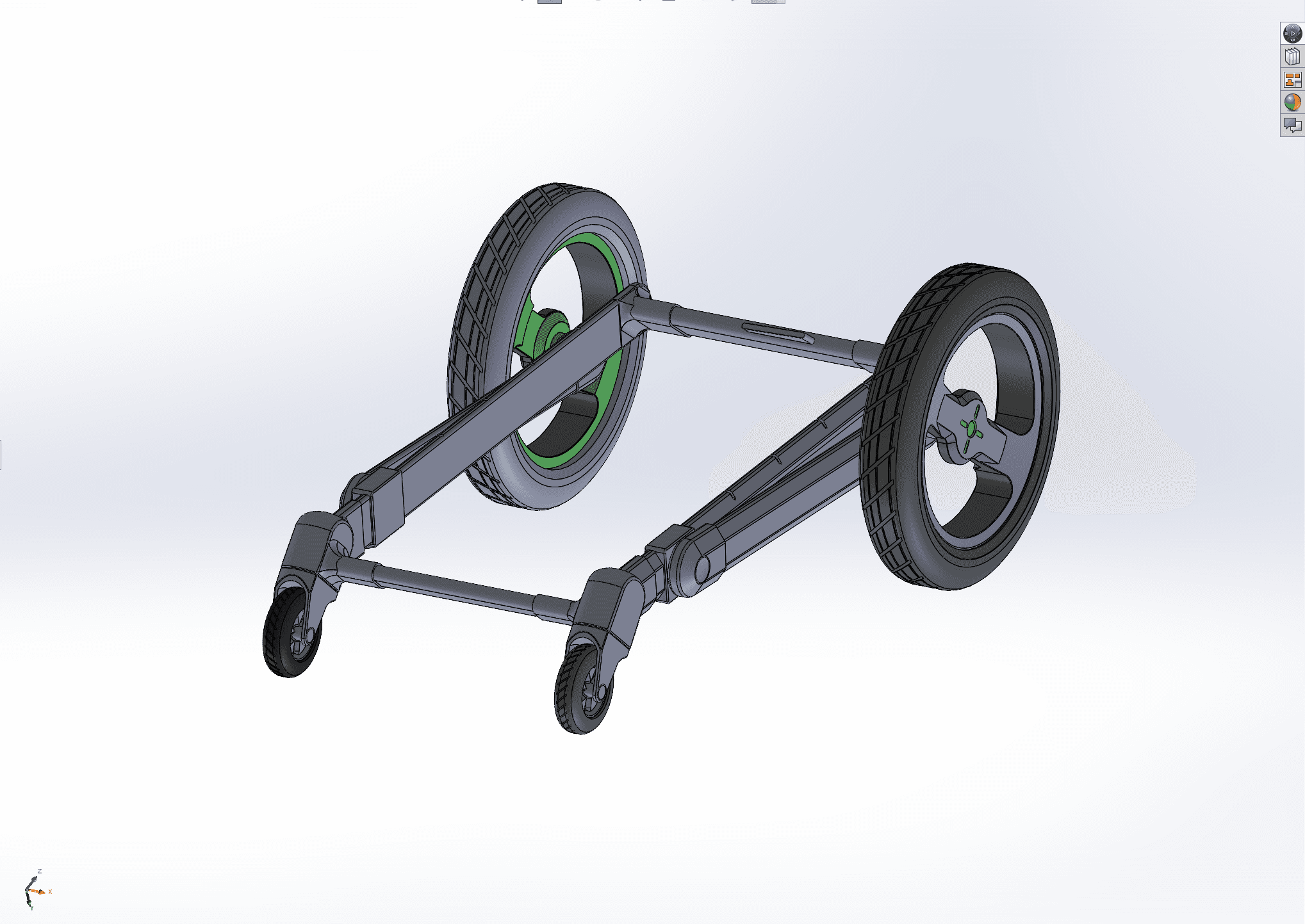
The chosen direction moves into SolidWorks to realize proportions, wheel and handle geometry, frame relationships, storage volume, part seams, and the 3D structure needed for final presentation renders.

06

Final

Final

Final